If you hold or plan to hold coins on an exchange that serves the EU, you can look the company up in a public register in about five minutes. The register is run by ESMA, the EU markets regulator, and it lists crypto-asset service providers (the legal name for exchanges, custodians and similar firms) that are authorised or notified under the EU's MiCA rules. This guide shows the lookup step by step, then shows what we found when we ran it on ten well-known brands. One result matters more than the rest: a name that is missing from the file is a reason to ask questions, but it is not proof of anything on its own.
What to know first
- The register is a set of downloadable CSV files on ESMA's MiCA page. ESMA says it publishes the latest version weekly, so a very recent change may not show yet.
- We downloaded the files on 23 November 2026. ESMA's page showed "Last update: 18 November 2026".
- The authorised-providers file had 409 rows on that date. A second file lists non-compliant entities and had 217 rows.
- Always search for the legal entity, not the brand. Bitpanda appears under three legal names and Kraken under two.
- A listing shows a firm is authorised or notified. It does not show the firm is safe, solvent or good value.
Our reading: the lookup is quick, but the traps are in the details, such as entity names, which services are covered and which countries are listed. Those are the parts this guide spends time on.
How we chose what to cover
We started from the question a reader actually has: "is this exchange allowed to serve me?" We did not use a search results page, because our search tool returned nothing in this session. Instead we went to the primary sources. We read ESMA's MiCA page (including its "About" text on how the register works), the text of Regulation (EU) 2023/1114 on EUR-Lex for Articles 59, 60, 109 and 143, and a Belgian regulator warning page for an example of a national notice. Then we downloaded both CSV files and ran the lookup ourselves. We tested ten brands we picked because readers commonly ask about them. We do not claim they are the most important ten, and we did not test any exchange for quality.
Terms used in this guide
| Term | Plain meaning |
|---|---|
| MiCA | The EU regulation on markets in crypto-assets, Regulation (EU) 2023/1114 |
| CASP | Crypto-asset service provider: a firm offering services such as custody, exchange or trading |
| ESMA | The European Securities and Markets Authority, which publishes the register |
| NCA | National competent authority, the regulator in each EU country that supplies data to ESMA |
| Authorisation (Article 63) | A CASP is approved by its home regulator to provide the listed services |
| Notification (Article 60) | Certain existing financial firms, such as banks, tell their regulator they will offer crypto services |
| Home member state | The EU country whose regulator supervises the firm |
| LEI | Legal entity identifier: a 20-character code that identifies a company worldwide |
| CSV | A plain table file you open in a spreadsheet |
What the primary sources say
Who may offer crypto services in the EU. Article 59 of MiCA says a person may not provide crypto-asset services in the Union unless it is an authorised CASP under Article 63, or a listed type of financial firm (a credit institution, investment firm and others) that is allowed to do so under Article 60. Article 59 also says a firm that is not a CASP must not use a name or marketing that suggests it is one. Source: Regulation (EU) 2023/1114 on EUR-Lex.
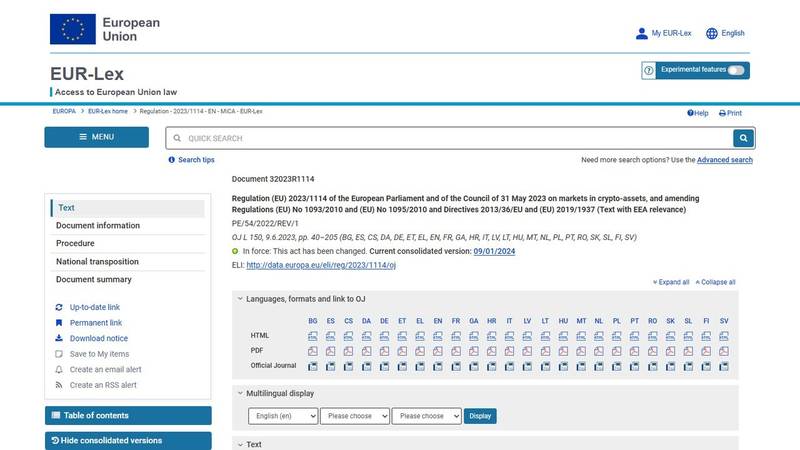
The transition period. Article 143(3) lets firms that already provided services under national law before 30 December 2024 continue until 1 July 2026, or until they are granted or refused an authorisation, whichever comes first. It also lets member states shorten that period or opt out of it. As of this article's date, 1 July 2026 has passed. So a firm that serves EU customers and has no register entry deserves a direct question. Which firms rely on a national exception is something we did not check for each country.
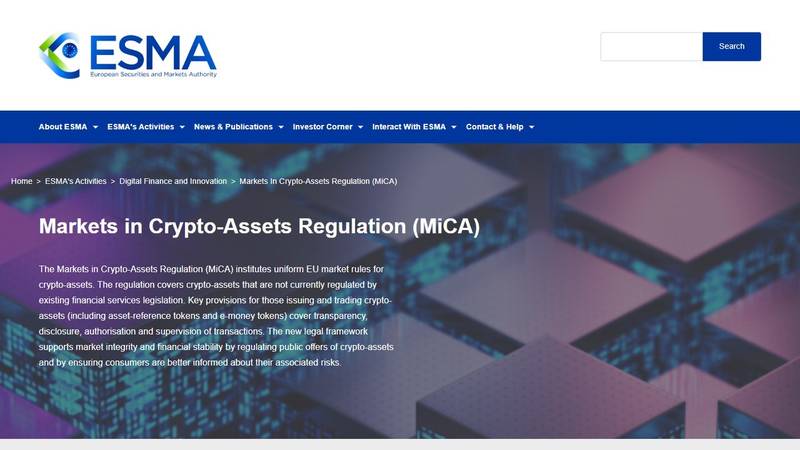
The register itself. Article 109 requires ESMA to keep a public register that includes crypto-asset service providers. ESMA's MiCA page explains that, to meet the legal deadline, it published an interim register as five CSV files: white papers, issuers of asset-referenced tokens, issuers of e-money tokens, authorised CASPs, and non-compliant entities. The page says records come from national authorities, the files are republished weekly, and a withdrawn authorisation stays in the file with its withdrawal date.
Step by step: how to look up an exchange
- Find the legal entity. Open the exchange's terms of service or website footer and note the company name and country, such as "Bitpanda GmbH, Austria". The brand name on the app is often not the registered firm.
- Download the file. On ESMA's MiCA page, under "Interim MiCA Register", download the crypto-asset service providers file. We used
CASPS.csvfrom ESMA's site. - Open it in a spreadsheet and search. Search for the legal entity, then the brand, then the website domain. If you know the LEI, search for it, because it is the cleanest match.
- Read the whole row, not just the name. Check the home member state and authority, the authorisation date, the end date (it should be empty), the list of services and the list of countries.
- Match services to what you use. The file lists services by letter. For example, "a" is custody and administration, "c" is exchange of crypto-assets for funds and "b" is operating a trading platform. If you want to trade and the row lists only custody, you have found a gap.
- Check the non-compliant file. Search the same name and website in the non-compliant entities file.
- Cross-check with the national regulator. ESMA's data comes from national authorities and is republished weekly, so the regulator in the firm's home country is the most current source.
Our test: ten brands, one lookup each
We searched the 18 November 2026 file for each name below. Dates are shown as the file prints them (day/month/year).
| Brand searched | Legal entity in the file | Home state | Authorisation date |
|---|---|---|---|
| Bitpanda | Bitpanda GmbH (also two other Bitpanda entities, see below) | AT | 09/04/2025 |
| Bybit | Bybit EU GmbH | AT | 28/05/2025 |
| Coinbase | Coinbase Luxembourg S.A. | LU | 20/06/2025 |
| Kraken | Payward Europe Solutions Limited, and Payward Global Solutions Limited | IE | 25/06/2025 |
| OKX | OKX Europe Limited | MT | 27/01/2025 |
| Crypto.com | Foris DAX MT Limited | MT | 27/01/2025 |
| Bitstamp | Bitstamp Europe S.A. | LU | 15/05/2025 |
| Bitvavo | Bitvavo B.V. | NL | 26/06/2025 |
| Gemini | Gemini Intergalactic EU Ltd | MT | 21/08/2025 |
| Binance | No match in either file | n/a | n/a |
What stood out when we did this ourselves:
- One brand, several entities. Bitpanda has three rows: Bitpanda GmbH (Austria), Bitpanda Asset Management GmbH (Germany) and BP23 CA Limited (Malta). They list different services. Kraken has two Irish entities, and one of them (Payward Global Solutions Limited) lists only service "b", operating a trading platform, while the other lists eight services. The entity you sign a contract with is the one that counts.
- Binance returned no match. We searched the text "binance" in names and website fields of both files and found nothing. That is a fact about this file on this date. It does not tell you why. The firm may not serve EU customers through an entity in this file, it may use a different legal name, or the data may lag the national regulators. Ask the firm which entity serves you, then check that entity.
- Home states. The most common home states in the authorised file are Germany (131 rows), France (36), the Netherlands (29), Cyprus (26) and Malta (24). In the file, 123 of the 131 German rows use the Article 60 notification route, which is the route banks and similar firms take.
Our reading: a match tells you the legal entity is on the list. A non-match tells you to keep looking. Neither answers whether the exchange is safe to use.
Reading the result: authorised, notified, withdrawn
The "legal basis" column separates two routes. In the file, 140 rows say "Article 63: CASP authorisation" and 159 say "Article 60: Notification", with a handful of other variants and 85 blanks. A notified bank is allowed to offer crypto services but has not gone through the same CASP authorisation, so do not read the two as the same thing. A blank legal basis is a gap in the data, not a finding.
Withdrawn firms stay in the file. We found three rows with an end date or end-date field filled in: Stratos Europe Ltd (Cyprus, end date 24/04/2026), Decubate B.V. (Netherlands, end date 26/03/2026, with a comment that the entity voluntarily asked to revoke) and Payhound Limited (Malta). If you see an end date, the authorisation is no longer active.
Data quirks to expect
These are real problems we ran into. None of them changes the lookup, but they can make you miss a match.
- Typos in the website field. Coinbase's row lists its website as "https.//coinbase.com" with a dot instead of a colon. Search by name or LEI as well as by domain.
- Odd characters. The file contains accented characters that show up garbled in some programs. If a name looks broken, open the file as UTF-8 or Latin-1, or search a shorter part of the name.
- Dates in two formats. Most dates are day/month/year. In the non-compliant file, two decision dates appear as five-digit numbers such as 45916, which is a spreadsheet date code.
- A name in the date field. Payhound Limited's end-date field contains the company name instead of a date, so we could not read its end date from the file.
- Dates in the future. Three German bank rows show authorisation dates after 23 November 2026: 25/11/2026, 03/12/2026 and 07/12/2026. We could not tell from the file whether these are start dates or entries ahead of time, and we did not read ESMA's field description file.
The non-compliant file
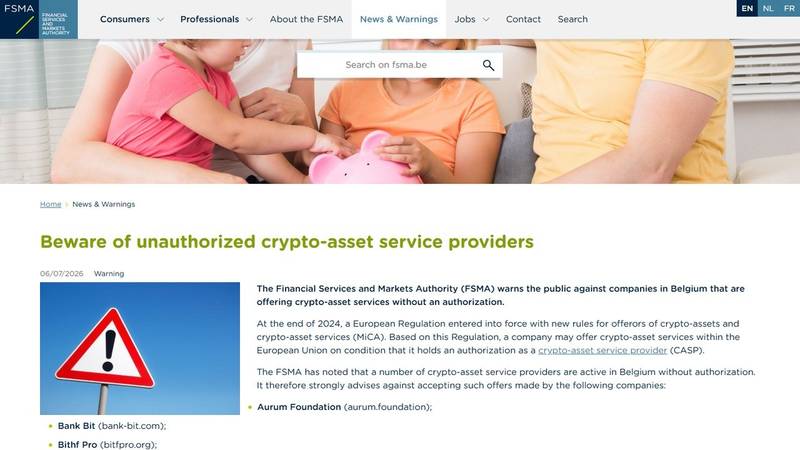
The second file lists entities that national authorities say provide crypto services without the required authorisation. It had 217 rows: 180 from Italy, 27 from Lithuania, 6 from Belgium and one each from the Czech Republic, Estonia, the Netherlands and Slovakia. The latest decision date was 18 November 2026. Entries are warnings from regulators about specific names and websites. For instance, Belgium's FSMA published a warning on its site dated 6 July 2026 about firms offering crypto services without authorisation, and the file lists several Belgian names with decisions dated 29 June 2026.
Our reading: the file is useful for checking a name you were given in a message or an ad. It is not a full list of scams. Most scam sites will never appear in it.
What we did not check
- National registers such as those of Germany, France, the Netherlands or Malta. We relied on ESMA's file.
- Whether any firm in our table serves you in your country, or which products you can use.
- ESMA's field description document, so some column meanings (such as the future dates) are our reading.
- The MiCA definition of each service letter. We used the labels printed in the file.
- Registers outside the EU, such as the UK FCA or US state lists.
- Which member states shortened or skipped the transition period under Article 143.
- Financial strength, insurance, proof of reserves or security of any exchange.
FAQ
Does being on the register mean an exchange is safe?
No. It means the legal entity is authorised or has notified its regulator. It says nothing about security, solvency or fees.
An exchange I use is not in the file. Is it illegal?
Not necessarily from this alone. Check the exact legal entity, search the LEI, check the national regulator and ask the firm. If it still cannot show an authorisation and it serves EU customers, treat that as a serious warning.
How often is the register updated?
ESMA says it republishes the files weekly. Changes reported by national authorities may take longer to appear.
What is the difference between authorised and notified?
Authorised firms went through the CASP authorisation under Article 63. Notified firms, such as banks and investment firms, told their regulator under Article 60 that they would offer crypto services.
Why does one exchange appear more than once?
Large groups often run several legal entities. Each is listed separately with its own services.
Where do I check outside the EU?
Each country has its own register. This guide covers only ESMA's MiCA register.
This article is for information only and is not financial, investment or legal advice. Register data is a snapshot of the ESMA files published 18 November 2026 and downloaded 23 November 2026, and may have changed since.