The best perpetual DEX is the one whose execution model, collateral path and failure handling match the trader’s workflow. Order-book venues make spread, queue and fill quality visible; pool-based venues require closer attention to oracle price, pool balance and price impact; Solana-native venues add route and confirmation risk; and newer venues need stronger evidence before a larger deposit.
For most traders, Hyperliquid is the clearest first order-book test, GMX is the clearest pool-and-oracle test, dYdX and Paradex suit traders evaluating dedicated-chain infrastructure, and Solana-native venues suit users who already accept wallet and route dependencies. No model is universally best: the right choice depends on order size, collateral, market coverage, exit path and the failure mode the trader can actually manage.

Quick comparison by trading requirement
| Venue | Execution model | Best fit | Main operational question | Main risk |
|---|---|---|---|---|
| Hyperliquid | Onchain order-book venue | Traders wanting a CLOB-style perp DEX | Can the intended market absorb the order without material impact? | Chain, wallet, protocol and backstop risk |
| dYdX | App-chain derivatives venue | Traders evaluating dedicated decentralized infrastructure | How dependable are current markets, deposits and withdrawals? | Chain operations and market-depth concentration |
| GMX | Oracle-priced positions against pools | Traders who prefer pool liquidity and transparent execution details | How do pool balance, oracle spread and collateral affect the position? | Oracle, keeper and pool imbalance risk |
| Aevo | Offchain matching with onchain settlement | Traders comparing a CEX-like interface with a non-custodial settlement path | Does the margin account reconcile across perps and options? | Matching, collateral and settlement dependency |
| Paradex | Starknet app-chain derivatives venue | Traders wanting a dedicated chain and unified account | How do account state, withdrawals and chain controls behave? | App-chain operations and recovery complexity |
| Gains Network | Synthetic and oracle-priced leveraged markets | Traders needing broad market or non-crypto exposure | How are price, liquidity and liquidation guarantees funded? | Oracle, counterparty and liquidity-model risk |
The table is a routing filter, not a live ranking. Use it to remove models that do not fit the trader’s operating ability, then run a matched test on the remaining candidates. The five-project perp DEX benchmark is the better reference when the question is which named protocol performs better under the same test.
6 Best Perpetual DEXs in 2026
Hyperliquid: onchain order-book execution with a self-custody boundary
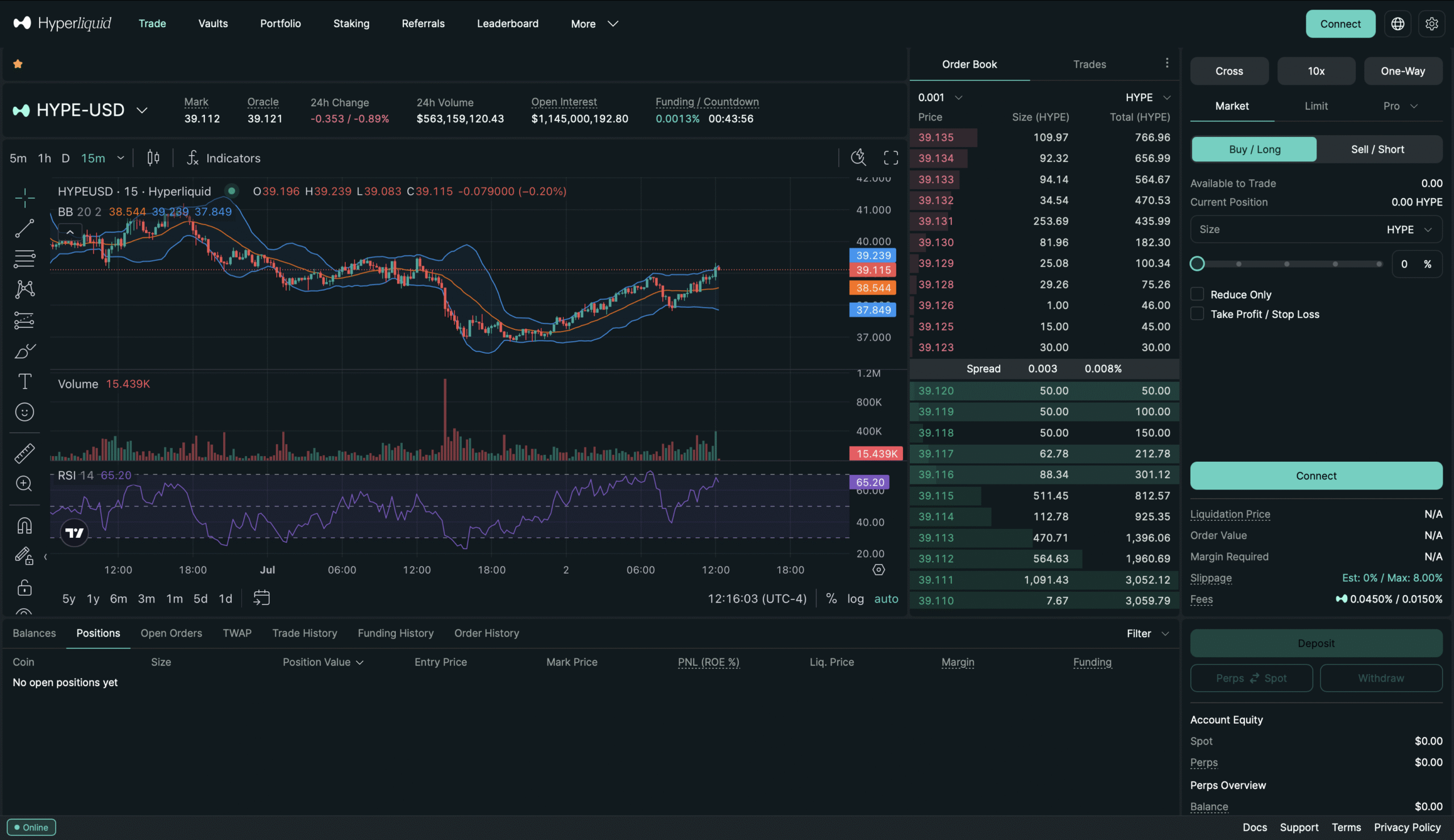
Hyperliquid is the clearest first candidate for traders who want an onchain perpetual venue that behaves like an order-book exchange. The useful question is not whether it calls itself decentralized; it is whether its visible market depth, order controls, funding, and liquidation path fit the position size. Its public interface exposes the trading workflow without requiring a conventional exchange account, which makes it easy to separate the trading wallet from long-term holdings.
That convenience does not eliminate protocol or infrastructure risk. A user still needs to understand how collateral moves onto the venue, how wallet signing is isolated, and how liquidation is handled when the book is stressed. The sensible first trade is a small isolated position followed by a reduce-only close and withdrawal. If that sequence is not clear, a faster interface is not enough reason to add size.
dYdX: dedicated-chain operations behind the derivatives market
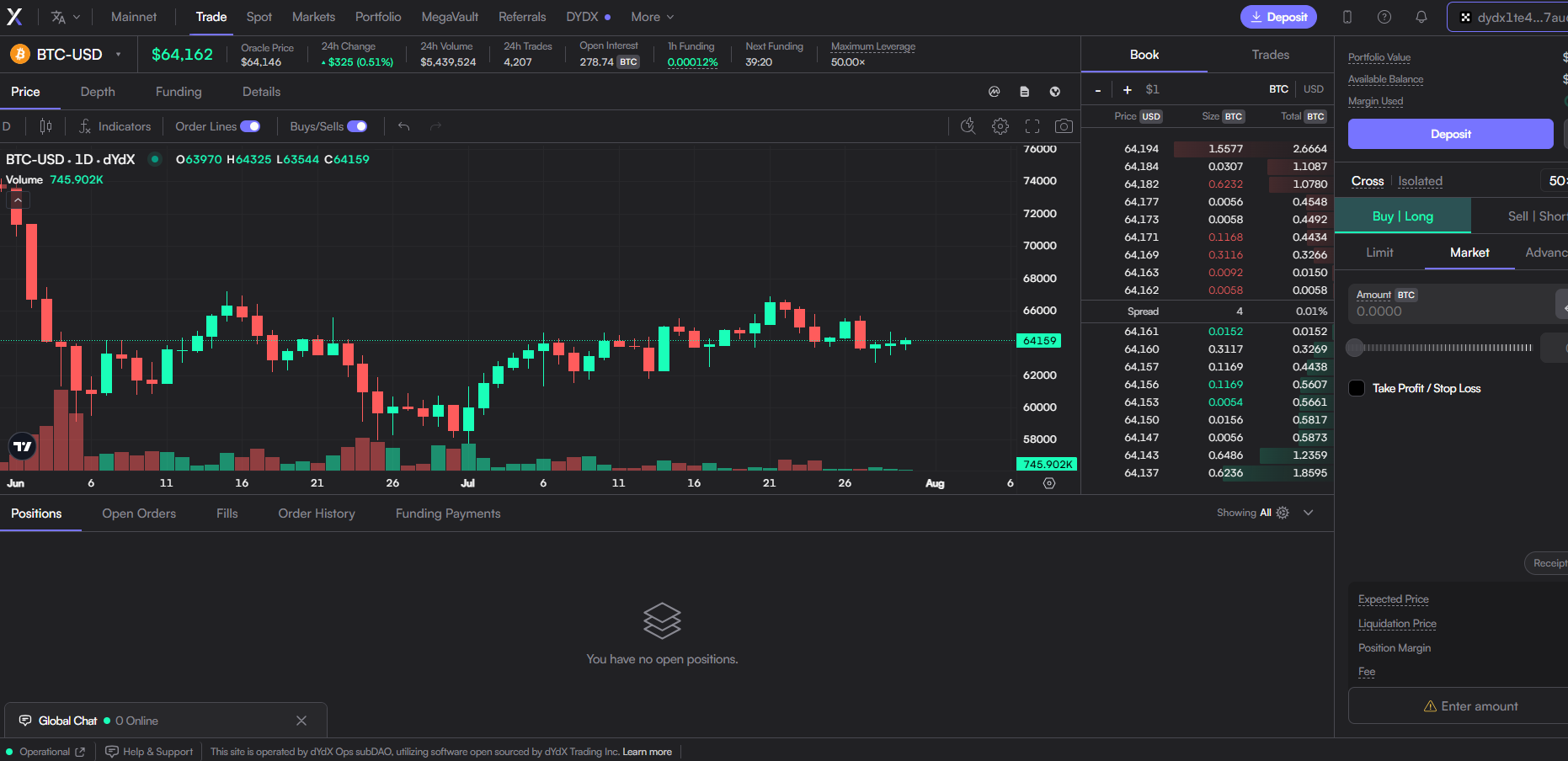
dYdX should be assessed as both a trading product and a dedicated chain environment. That changes the diligence questions. A trader needs to know how the current chain is operating, how markets are maintained, how collateral is funded, how withdrawals work, and what happens if the chain or a market-making process is temporarily unavailable. The public dYdX product is the correct starting point for a current capture.
Its architecture may appeal to users who want a decentralized derivatives environment rather than a wallet connected to a general-purpose application. The trade-off is that decentralization language cannot replace a matched comparison of spread, depth, funding, collateral, and recovery. If a chosen market cannot be exited at the intended size, the architecture has not solved the trader’s actual problem.
GMX: pool liquidity, oracle pricing, and position exposure
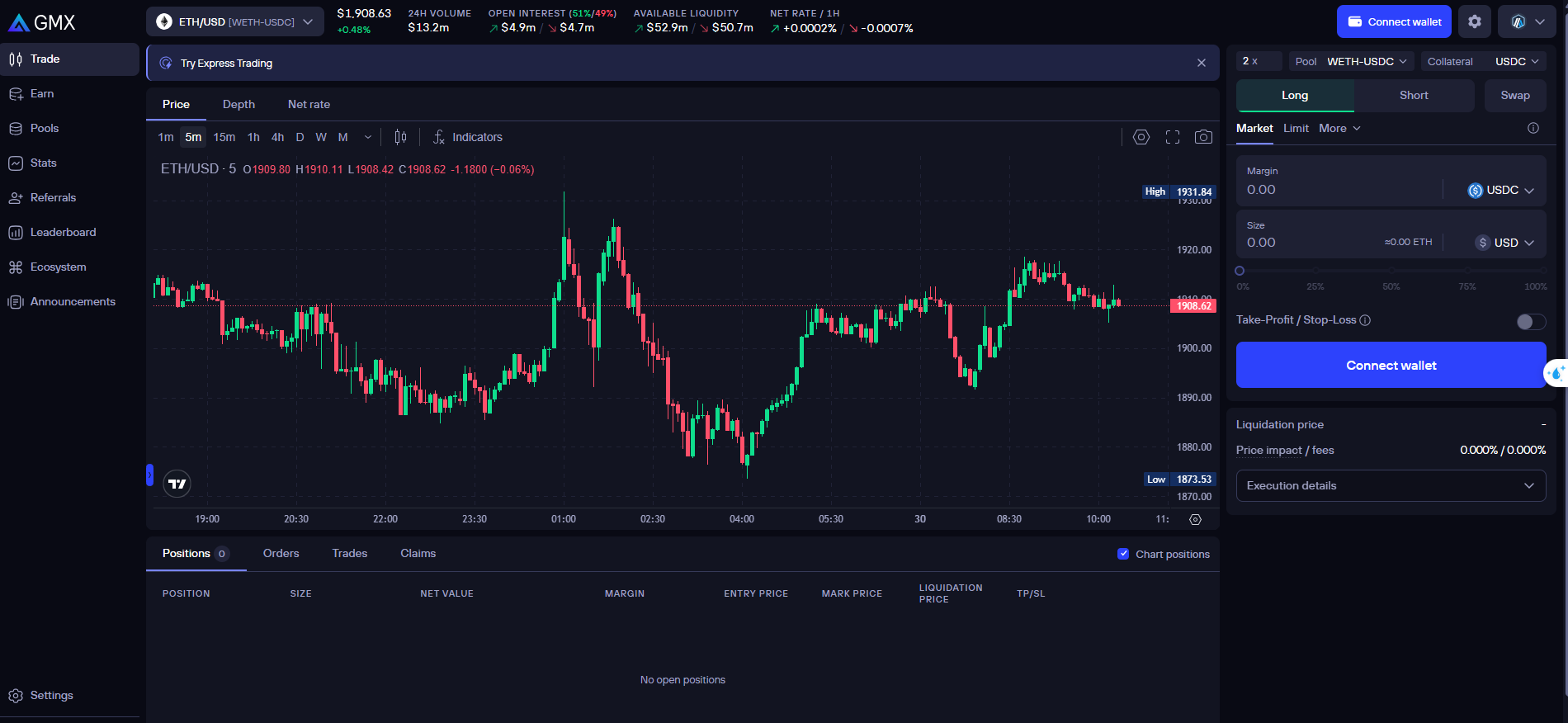
GMX is not an order-book DEX. The trader interacts with oracle-priced positions against liquidity pools, so “liquidity” means something different from visible bids and asks. A user should inspect the price shown before confirmation, the pool selected, collateral token, allowed slippage, position size, liquidation price, and the fee details that appear in the trade flow.
The model can be attractive for traders who prefer a direct onchain position workflow, but it has a distinctive risk profile. Pool balance can affect price impact and borrowing conditions. A non-stable collateral token can change the account’s effective exposure. Trigger orders are not the same as passive orders resting in a queue, and a fast oracle move can create a gap between the trigger the user expected and the price at which the keeper executes.
Aevo: offchain matching, onchain settlement, and unified margin
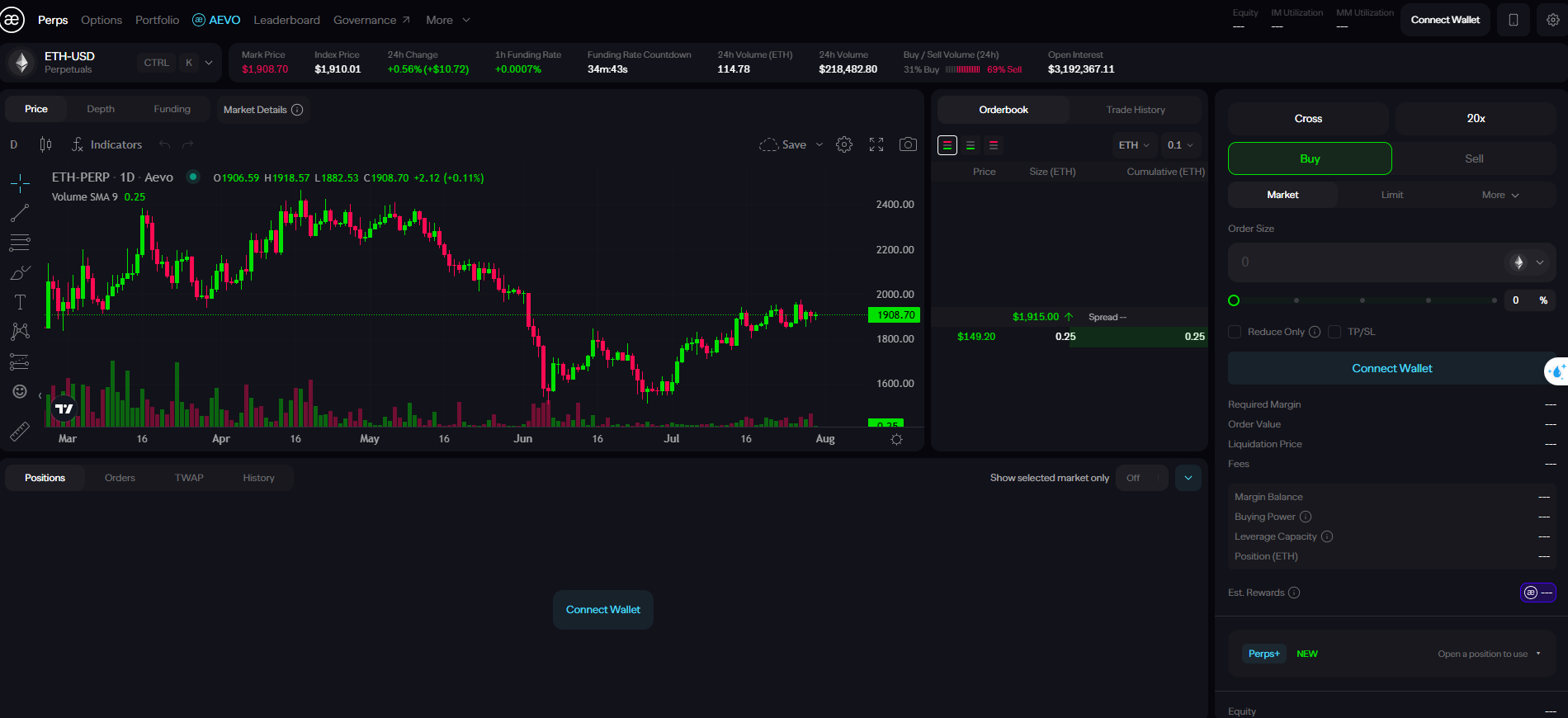
Aevo deserves a separate test because it combines offchain order matching with onchain settlement and supports perpetuals alongside options. That makes the execution experience closer to a centralized venue, but the diligence question shifts to how the unified margin account, settlement transaction and withdrawal path reconcile after the fill.
Use the Aevo public exchange to capture the actual market, margin and settlement workflow. Compare the same BTC or ETH notional with the other DEX candidates, and record whether the account view, fill record and settlement state agree after an order is closed.
Paradex: app-chain execution and account-state diligence
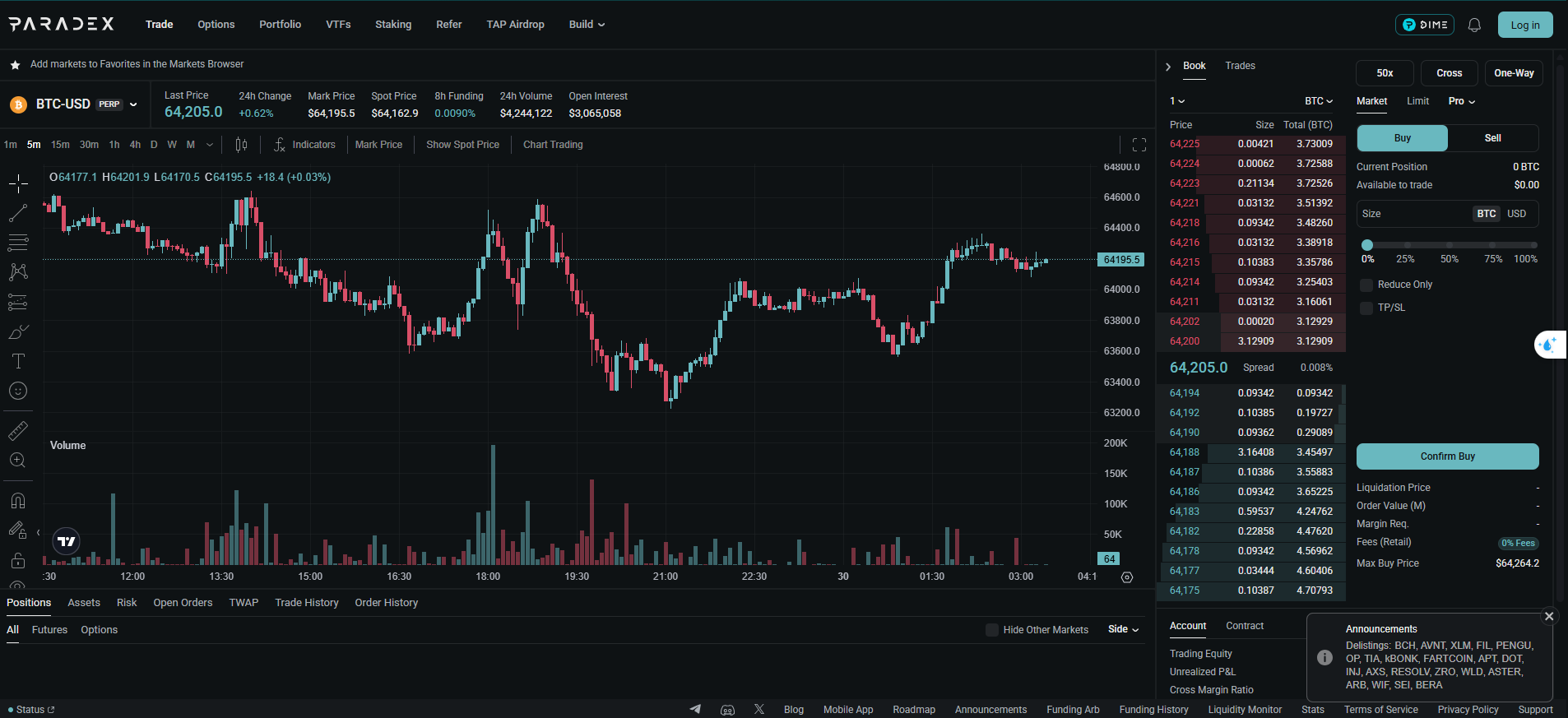
Paradex belongs in the app-chain category rather than the generic CLOB bucket. Its exchange and chain should be evaluated together: record collateral, account state, order status, withdrawals, operational controls, and the exact point at which the trader relies on the app-chain rather than Ethereum settlement.
A purpose-built chain can improve throughput without removing chain downtime, account recovery or withdrawal risk. Do not award Paradex a broad “best” label without a dated product capture and a small round trip that includes an order, a partial close, a full close and a withdrawal of unused collateral.
Gains Network: synthetic markets and oracle-funded leverage
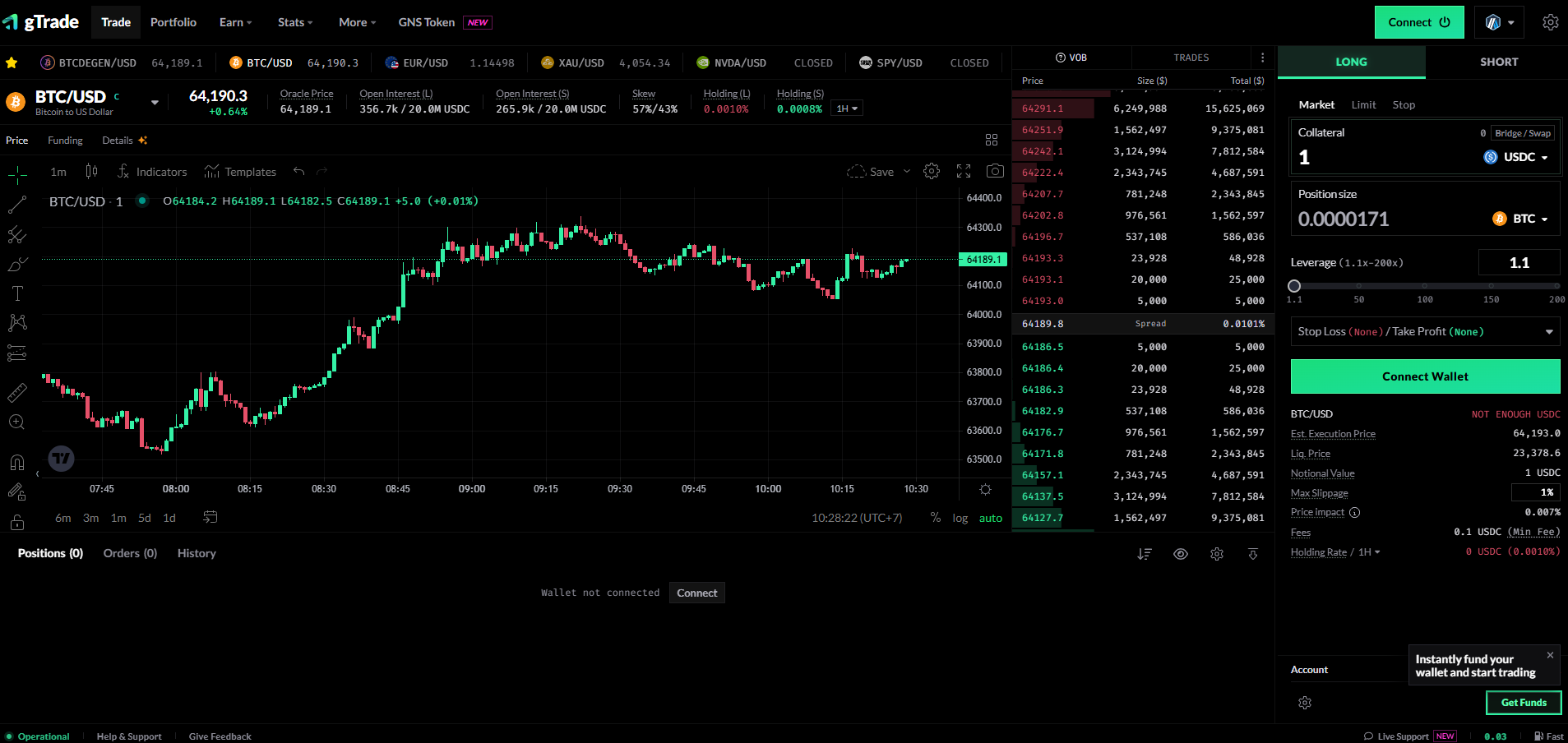
Gains Network changes the comparison because its gTrade model is designed around synthetic leveraged markets rather than a conventional order book. It can be relevant for traders comparing crypto with forex, commodities or indices, but the evidence standard is different: verify the price source, liquidity mechanism, execution guarantee, leverage limit and liquidation process for the exact market.
For a fair test, use a small market with a clearly documented price source and compare quoted versus realized execution. Record the spread, price impact, funding or borrowing cost, liquidation buffer, close guarantee and collateral withdrawal. The altcoin market context is a useful reminder that broad token coverage does not guarantee executable depth. A broad market list is not an advantage if the risk engine or liquidity source cannot be verified.
What separates a useful perp DEX from a convincing demo?
The first test is execution at the user’s actual notional. A platform can show a fast interface and still produce poor results if the book is thin, the pool applies negative price impact, or a keeper executes after the price has moved. Record the displayed quote, expected output, realized fill, spread, and price impact for the same BTC or ETH size on each shortlisted venue. Do not use headline volume as a substitute for this test.
The second test is the loss boundary. Isolated margin should be evaluated separately from cross or portfolio-style collateral. Ask which price determines liquidation, whether a position can be partially reduced, how the backstop works, and what remains after a rapid move. The leverage-risk comparison explains why maximum leverage is a poor selection metric. High leverage does not make a DEX better; it only makes the distance between ordinary volatility and liquidation smaller.
The third test is recovery. A trader should be able to fund the wallet, open a small position, close it with a protective order, withdraw the remaining collateral, and understand a failed transaction without contacting a support desk. Self-custody gives the user more direct control, but it also makes wallet hygiene, chain selection, signing permissions, and transaction verification part of the trading skill.
A $10,000 perp DEX comparison that avoids headline fees
Assume the same $10,000 notional is opened and closed on each venue. The comparison should record the following rather than only the advertised trading fee:
| Measurement | What to record | Why it changes the decision |
|---|---|---|
| Entry and exit quote | Expected price and realized fill | Shows spread and execution drift |
| Price impact | Percentage and dollar amount | Separates deep execution from a cheap headline rate |
| Funding or borrow | Rate and holding interval | Converts a short-term quote into a position cost |
| Gas or keeper cost | Wallet and execution overhead | Matters more for small onchain positions |
| Liquidation buffer | Mark price, maintenance margin, liquidation price | Shows how much volatility the collateral can absorb |
| Exit path | Close, withdraw, bridge or conversion steps | Measures recovery friction after trading |
For example, a 0.10% loss on entry and another 0.10% on exit costs $20 on $10,000 before funding and network costs. A nominally cheaper venue can still be worse if its price impact is larger. Conversely, a slightly higher visible fee may be acceptable when the venue gives a cleaner fill and a simpler exit. Keep the capture date beside every value because markets, parameters, and route availability change. The wider perpetual exchange cost guide explains why headline fee alone is insufficient.
How to test a perp DEX before using meaningful capital
First verify the public product, chain, token contract, market, collateral, and current availability. Use a dedicated trading wallet and keep long-term assets elsewhere. Deposit the smallest practical amount, open an isolated position, inspect mark and liquidation prices, place a limit order, close with reduce-only, export the transaction record, and withdraw the unused balance.
Next test the failure path. Reject an order intentionally, cancel an unfilled order, observe a transaction that needs confirmation, and check whether the interface explains a failed or delayed action. For systematic trading, test stale market data, duplicate order retries, rate limits, key revocation, and the emergency close. A DEX that works only on the happy path is not ready for a larger balance.
The custody decision should be tested against the user’s recovery ability, not treated as a branding preference. Compare the wallet-and-protocol boundary with the account-and-withdrawal boundary described in the CEX versus DEX comparison before deciding how much capital belongs on a perp venue.
Pick the operating model you can actually manage
Hyperliquid is the first venue to test for an onchain order-book experience. dYdX is a separate chain-and-market-operations comparison. GMX is the right reference point when pool and oracle execution are part of the decision. Aevo deserves the offchain-matching test, Paradex the app-chain test, and Gains Network the synthetic-market test. Traders planning automation should also review the trading-agent operational model before treating a public interface as bot-ready.
The next action is not to deposit into the highest-ranked row. Capture the same market and notional on two or three venues, complete a small open-close-withdrawal cycle, and record the cost layers. That produces a decision based on the failure mode the trader can contain, not on a generic claim that one perp DEX is best for everyone.
FAQs
Is a perpetual DEX safer than a centralized exchange?
Not automatically. A DEX can reduce exchange-account dependency, but the trader still carries wallet, smart-contract, oracle, chain, keeper, and liquidity risk. A centralized exchange adds custody and jurisdiction risk but may offer simpler recovery and deeper major-pair execution.
Which perp DEX is best for beginners?
Start with the venue whose margin, liquidation, close, and withdrawal screens are easiest to understand, not the venue advertising the highest leverage. Use isolated margin, a small notional, and a completed withdrawal test before considering larger positions.
Are oracle-priced perps better than order-book perps?
Neither model is universally better. Order books make queue and displayed depth easier to inspect; oracle-priced pools can provide a different access model but require closer attention to oracle spreads, pool balance, keeper timing, and price impact.
Can I compare DEXs using 24-hour volume?
Volume is useful context, but it cannot answer whether your order will fill well. Compare spread, depth at your notional, realized price impact, funding, liquidation behavior, and the ability to close and withdraw.
Disclaimer: This article is for informational purposes only and does not constitute financial or investment advice. Cryptocurrency and digital asset markets carry significant risk. Always do your own research before making decisions.