





dYdX is the stronger first choice for traders who value a longer-running app-chain derivatives environment, explicit short-term and long-term order behavior and isolated-market controls. Lighter is the stronger fee-sensitive option when its Standard Account latency is acceptable or when a Premium Account’s faster execution justifies the fee.
Both venues use order books, so a generic CLOB description does not separate them. The meaningful comparison is how an order becomes state, how matching can be verified, what the account tier changes, and how margin, liquidation and recovery cross each venue’s chain boundary.

dYdX vs Lighter: direct structural comparison
| Comparison factor | dYdX | Lighter | Edge |
|---|---|---|---|
| Core architecture | Dedicated derivatives app-chain | ZK rollup anchored to Ethereum | Different security and recovery models |
| Matching model | Validator-operated order-book environment | Price-time matching with validity proofs | Lighter for cryptographic matching evidence |
| Order persistence | Short-term orders in validator memory; long-term orders committed onchain | Rollup order state coordinated by the sequencer | dYdX exposes a clearer order-duration split |
| Retail fee model | Maker/taker tiers based on trailing volume | Standard 0% maker and taker with added latency | Lighter Standard |
| Faster account model | Same public tier framework | Premium fees begin around 0.004% maker and 0.028% taker | Depends on urgency |
| Funding | Hourly market funding | Hourly peer-to-peer funding | Similar interval, different market result |
| Margin emphasis | Cross and isolated market controls | Account and market risk enforced by the rollup engine | Strategy-specific |
| Recovery boundary | Wallet, dYdX Chain account and validators | Wallet, rollup sequencer and Ethereum escape path | Different operational burden |
The table highlights why this article cannot follow the same format as a broad perpetual DEX shortlist. dYdX and Lighter both provide a familiar book, but the same limit order has different persistence, latency and failure behavior under each architecture.
dYdX offers a more established operational frame for traders who want to distinguish ephemeral trading instructions from orders that persist onchain. Lighter offers a sharper economic trade-off: its Standard Account removes explicit trading fees while deliberately accepting more latency, and its Premium Account charges for faster handling.
Order state: validator memory versus ZK-proved matching
The dYdX trading product separates short-term and long-term instructions. In the mechanism reviewed on August 13, 2026, short-term orders can remain in validator memory for up to 20 blocks, while long-term orders can remain onchain for up to 90 days. That split affects cancellation, persistence and what a trader should expect after a client disconnects.
Short-term state is useful for active quoting because it avoids placing every update into long-lived chain state. It also means a trader should not assume that a locally submitted order remains valid indefinitely. Long-term conditional orders provide a more persistent route, but they introduce explicit onchain state and margin requirements.
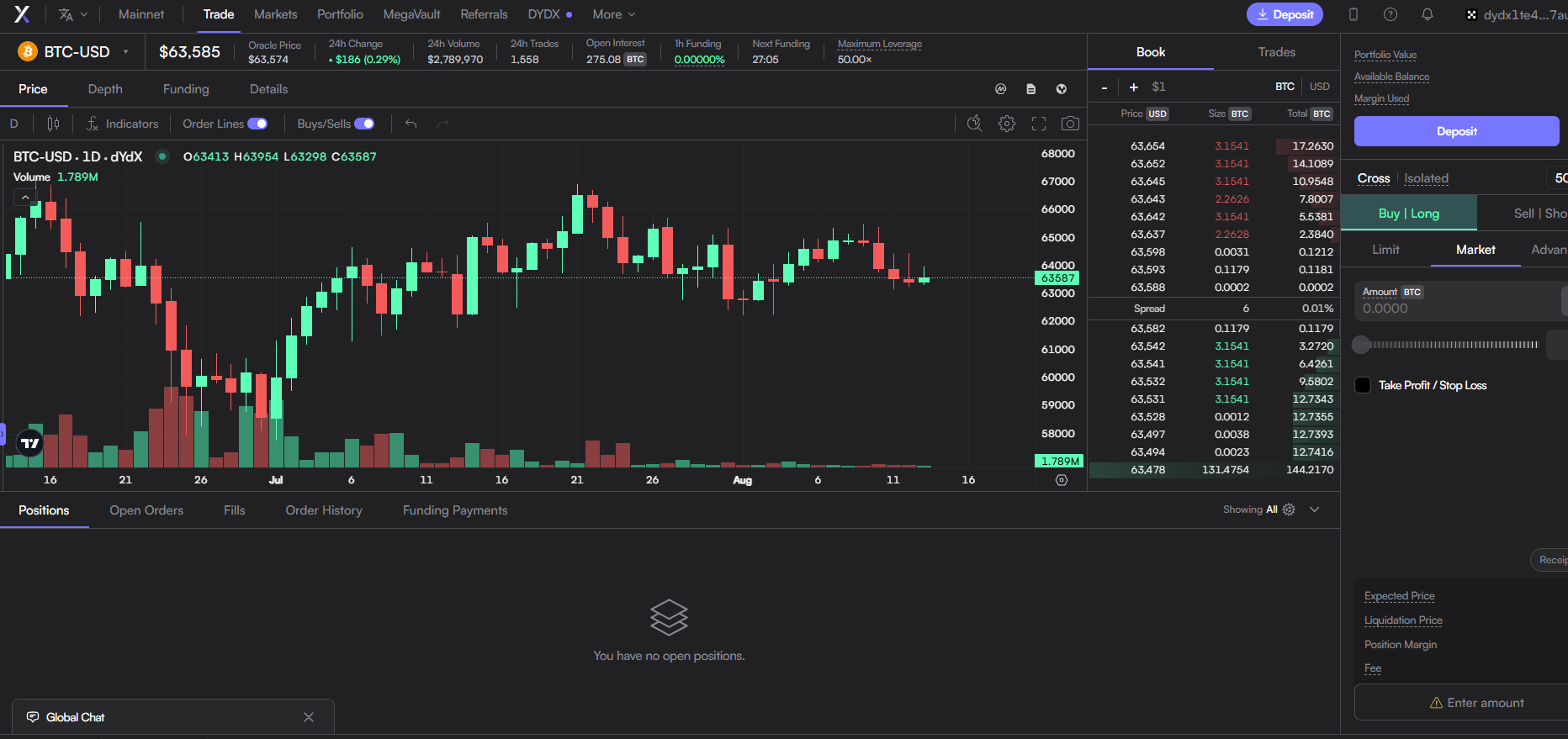
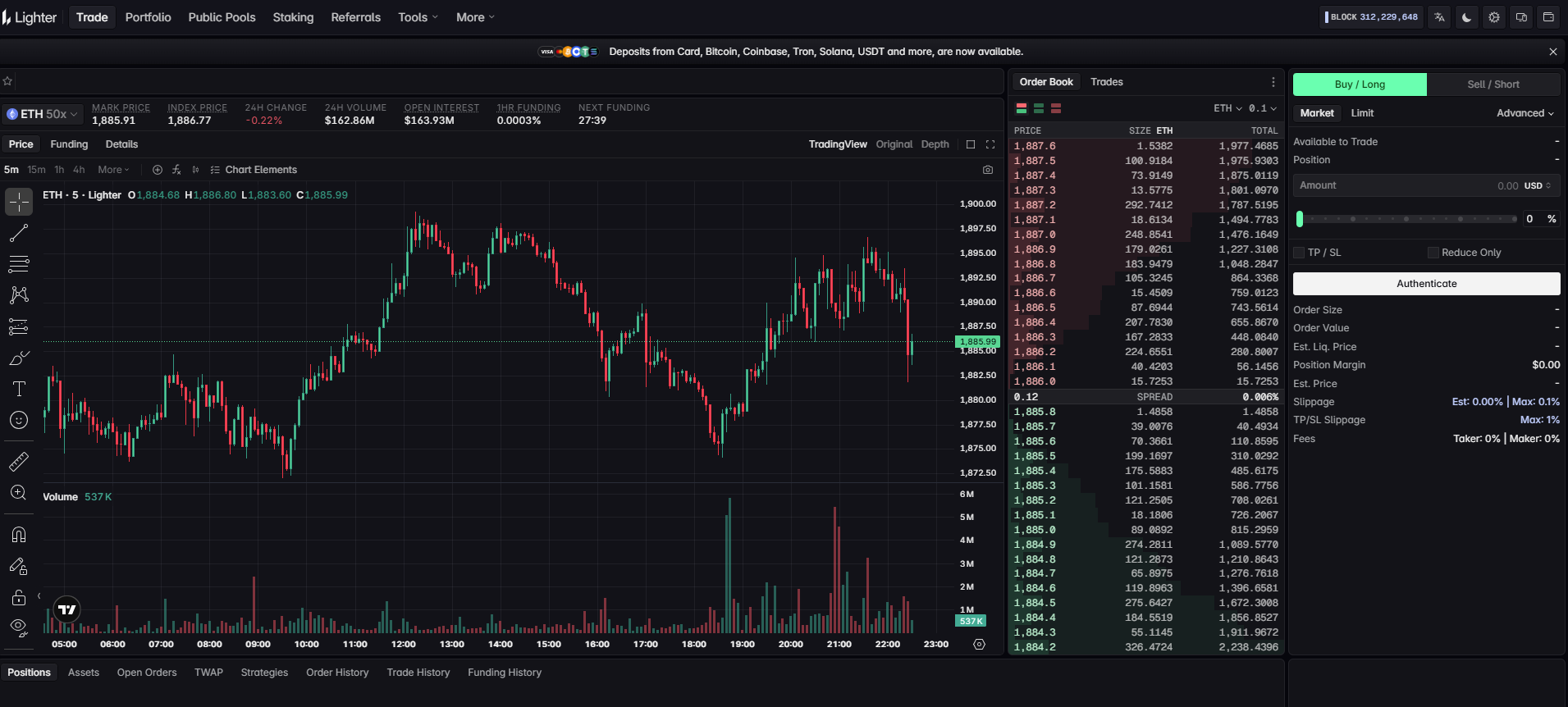
The Lighter trading app uses price-time priority and produces proofs for valid state transitions. Its market-order protection can limit the average execution price, which means an aggressive order may fill only partially rather than cross beyond the configured protection. Post-only, reduce-only, immediate-or-cancel and time-based controls let the trader define the intended behavior more precisely.
Lighter’s matching proof is meaningful evidence that the rollup followed its rules. It does not prove that the book contained enough size, that a quote remained available, or that the final fill beat dYdX. Execution quality still depends on spread, depth, cancellation timing and the trader’s position in the queue.
| Order event | dYdX behavior to inspect | Lighter behavior to inspect |
|---|---|---|
| Passive limit order | Short-term expiry, queue and validator propagation | Price-time priority, post-only result and account latency |
| Long-lived trigger | Onchain long-term order state | Trigger acceptance and rollup state |
| Market order | Average fill against available book | Average-price protection and possible partial fill |
| Cancel request | Validator acknowledgement and expiry | Cancellation latency by account type |
| Client disconnect | Difference between short-term and long-term persistence | Sequencer state and visible open-order record |
The stronger order model depends on failure preference. dYdX is easier to reason about when a trader deliberately separates short-lived quotes from persistent protection. Lighter is stronger when proof of price-time matching and explicit execution protection matter more than the app-chain order distinction.
Fees: volume tier versus latency tier
dYdX applies a maker-taker schedule tied to trailing trading volume. Canceled orders do not create trading fees, and normal trading does not add a separate gas charge by default. The account’s live rate still needs to be captured because a static article value can become stale after a governance or fee-schedule change.
Lighter makes a different offer. Its Standard Account currently applies 0% maker and 0% taker fees, but adds deliberate handling latency: roughly 300 milliseconds for taker actions and 200 milliseconds for maker and cancel actions in the reviewed schedule. The Premium starting tier charges about 0.0040% maker and 0.0280% taker while reducing the execution delay.
| Account route | Explicit trading charge | Added handling latency in the reviewed schedule | Suitable order behavior |
|---|---|---|---|
| dYdX live tier | Current maker or taker rate | No comparable account-tier delay disclosed in this comparison | Orders where app-chain state and current book quality justify the fee |
| Lighter Standard | 0% maker and 0% taker | About 300 ms for taker actions; 200 ms for maker and cancel actions | Non-urgent orders where zero explicit fee matters |
| Lighter Premium starting tier | About 0.0040% maker and 0.0280% taker | Lower-latency handling than Standard | Faster orders where reduced delay is worth paying for |
Lighter Standard is not a free execution guarantee. Its saving equals the fee that would otherwise apply to the trader’s actual executed notional, while its cost can appear through a changed quote, lost queue position or slower cancel. Premium reverses part of that trade-off by charging an explicit rate for faster handling.
dYdX should not be converted into the same account-tier framework. Its comparison point is the live maker or taker rate against the order’s realized spread and fill. Lighter wins only when the Standard fee saving or Premium latency advantage survives that execution comparison; the notional itself should come from the intended order rather than an editorial example.
A trader in a June 2026 perp DEX usage discussion described Lighter’s zero-fee model as useful for personal crypto trades while ranking dYdX lower for that workflow. This is one account-specific experience, not proof of superior fills. It supports testing Lighter Standard for low-urgency orders and recording whether latency costs more than the fee saved.
The Coinwy maker-taker analysis provides the correct accounting frame. Explicit fees, rebates, spread, price impact, non-fill risk and latency must be converted into one realized cost rather than compared as isolated labels.
Funding and holding-period economics
Both products apply funding on an hourly cadence, but the observed rate belongs to the selected market and side. A trader should add every settled interval across the position’s actual lifetime. One favorable reading does not establish the cost of a multi-day hold.
dYdX’s app-chain environment makes funding part of the market’s ongoing position state. Lighter describes funding as peer-to-peer between long and short exposure. The economic result remains familiar: the crowded side can pay, and the receiving side can still lose from adverse price movement.
| Holding pattern | dYdX focus | Lighter focus | Decision |
|---|---|---|---|
| Minutes to a few hours | Fee tier, spread and immediate fill | Standard latency versus Premium fee | Compare realized execution |
| Multi-day directional position | Cumulative funding and isolated margin | Cumulative peer-to-peer funding | Lower total carry wins |
| Repeated passive quoting | Maker economics and short-term order state | Zero-fee Standard latency or Premium maker fee | Strategy-specific |
| Funding arbitrage | Market basis, transfer timing and chain route | Market basis, latency and Ethereum route | Requires separate two-leg accounting |
The Coinwy funding-rate coverage explains why funding should be measured over the complete hold. Rewards, points or fee promotions should be excluded from the core comparison unless they are realizable, current and available to the specific account.
Margin and liquidation: app-chain controls versus rollup risk engine
dYdX supports isolated-market behavior that keeps a selected position from automatically sharing all account collateral. Long-term orders in an isolated position can require a dedicated USDC margin allocation. The reviewed liquidation mechanism uses oracle-based risk checks, can liquidate part or all of a position through protocol-generated orders and applies a default maximum liquidation penalty of 1.5%.
That penalty is not the full loss calculation. The trader can also lose from the adverse price move, spread, funding and execution against available liquidity. The insurance fund addresses protocol deficits; it does not restore the user’s original collateral after a valid liquidation.
Lighter enforces margin and liquidation through its rollup risk engine. The reviewed design can route distressed exposure through its liquidation mechanism and LLP backstop, with a liquidation fee that can reach 1% under the described path. The account still bears market loss, funding and execution effects before the backstop becomes relevant.
| Risk item | dYdX | Lighter |
|---|---|---|
| Price input | Oracle-informed risk checks | Protocol market and risk-engine inputs |
| Position isolation | Explicit isolated-market support | Confirm account and market configuration |
| Liquidation execution | Protocol-generated orders against liquidity | Liquidation engine with LLP backstop |
| Published penalty reference | Up to 1.5% default maximum in reviewed mechanism | Up to 1% in reviewed liquidation path |
| Main hidden risk | Validator, depth and chain-state dependence | Sequencer, depth and rollup-state dependence |
The comparison favors neither venue at maximum leverage. A lower leverage setting and a deliberate collateral buffer matter more than the difference between the published penalty references. Coinwy’s leverage-risk report provides the broader context for why the displayed liquidation price should remain far from an ordinary intraday move.
Recovery: validator chain versus Ethereum escape path
dYdX recovery crosses the wallet, the dYdX Chain account, validators and the selected deposit or withdrawal route. The dYdX status page can distinguish a public incident from an account-specific problem, while wallet and chain history provide the transaction evidence.
Lighter recovery crosses the wallet, sequencer, rollup state and Ethereum settlement layer. The architecture includes an escape path for critical priority requests that are not processed, but using an emergency mechanism is not equivalent to an ordinary withdrawal. The Lighter status page and Lighter public site provide service context, while the user’s signed transactions establish the account record.
This is the clearest architectural trade-off. dYdX asks the trader to understand a dedicated app-chain account and validator environment. Lighter asks the trader to understand a rollup operator and Ethereum-anchored recovery. Coinwy’s DEX-versus-CEX guide helps separate these protocol dependencies from centralized account custody.
The winner by trading workflow
| Workflow | Better first test | Reason |
|---|---|---|
| Non-urgent retail order with fee sensitivity | Lighter Standard | Zero explicit maker and taker fee |
| Latency-sensitive taker execution | Compare dYdX with Lighter Premium | Standard latency can dominate the saving |
| Persistent conditional protection | dYdX | Clear long-term onchain order category |
| Verify matching-rule compliance | Lighter | ZK-proved state transition model |
| Isolate a market-specific position | dYdX | Explicit isolated-market framework |
| Prefer Ethereum-anchored rollup recovery | Lighter | Escape path differs from app-chain recovery |
Conclusion
dYdX wins for traders who value mature app-chain operations, explicit short-term and long-term order behavior and isolated-market controls. Lighter wins for fee-sensitive traders who can tolerate Standard Account latency, or for traders willing to pay the Premium schedule for faster handling and ZK-proved price-time matching.
The final choice should come from the same contract and order type. Record acknowledgement, average fill, cancellation time, fee, funding, margin state and withdrawal completion. dYdX deserves the position when its app-chain route provides the clearer operational record; Lighter deserves it when fee savings or matching proofs remain valuable after latency and recovery are included.
FAQs
Is Lighter cheaper than dYdX?
Lighter Standard has zero explicit maker and taker fees in the reviewed schedule, but intentional latency can create execution cost. Lighter Premium and dYdX both require the live fee tier and realized fill to determine the cheaper result.
Does Lighter’s ZK proof guarantee a better fill?
No. It verifies valid matching and state transitions. Spread, depth, queue position and market movement still determine execution quality.
Is dYdX safer because it has operated longer?
Longer operation provides more public evidence, not a guarantee. dYdX still carries wallet, app-chain, validator, oracle, market and liquidation dependencies.
Which venue is better for market makers?
dYdX offers a familiar volume-tier and short-term-order environment. Lighter offers a zero-fee Standard tier with latency and a paid Premium route with faster handling. The better venue is the one with stronger realized spread capture after adverse selection and cancellation behavior.
Disclaimer: This article is for informational purposes only and does not constitute financial or investment advice. Cryptocurrency and digital asset markets carry significant risk. Always do your own research before making decisions.
Related: Vitalik Buterin Advocates Decentralized Computing for 2026



