


Hyperliquid is the better first test for fast onchain order-book execution; dYdX is the better fit for traders evaluating a dedicated derivatives chain. Neither is universally safer or cheaper.
Choose between them by matching the same market, notional, collateral, holding period and exit path. The winner is the venue whose depth, chain operations, liquidation route and recovery process fit your workflow.
Related guides: Best Centralized Exchanges in 2026: Fees, Margin and Custody, Best Telegram Casinos in 2026: TON Mini-Apps and Bot Casinos That Play Inside Telegram, and Best Stablecoin Payment Platforms in 2026: USDT, USDC and Business Crypto Rails Compared

Hyperliquid vs dYdX: structural comparison
| Decision factor | Hyperliquid | dYdX |
|---|---|---|
| Trading model | Onchain order-book venue with spot and perpetual markets | Dedicated decentralized derivatives chain and app |
| Strongest use case | Self-custody trading with visible order-book execution | Traders comparing an app-chain derivatives environment |
| Execution edge to test | Order-book depth, spread and fill quality at target notional | Order-book depth, market availability and chain response |
| Product scope | Spot and perpetual markets, with additional builder-deployed markets subject to current availability | Primarily perpetual markets on a dedicated derivatives chain |
| Custody boundary | Wallet signing, protocol margin and chain operations | Wallet, chain account, validators and protocol operations |
| Settlement environment | Hyperliquid L1 account and protocol settlement | dYdX Chain account and validator-backed settlement |
| Fee model | Maker/taker schedule with volume and staking-related tiers; rates can change | Maker/taker schedule based on trailing trading volume and governance parameters |
| Margin and liquidation | Protocol margin, mark price and liquidation backstop | Chain account, collateral rules, mark price and liquidation process |
| Governance and operations | HYPE-linked ecosystem and protocol governance | DYDX governance and validator ecosystem |
| Main risk | Wallet, protocol, chain and liquidation backstop risk | Chain operations, market depth and validator dependencies |
The table shows why the two venues should not be judged by the word decentralized alone. Hyperliquid combines spot and perpetual markets with an order-book workflow designed for users who want visible quotes and direct wallet control. dYdX is more narrowly optimized around derivatives on its own chain, so the relevant comparison is not simply interface speed; it is whether a trader values a focused app-chain environment enough to accept another layer of chain and validator dependency.
The custody boundary also changes the decision. Hyperliquid puts more emphasis on wallet signing, protocol state and the liquidation backstop, while dYdX adds chain-account operations and validator-backed settlement to the wallet and market risks.
A trader who wants a broad venue and familiar order-book behavior may start with Hyperliquid; a trader researching dedicated derivatives infrastructure may prefer dYdX, provided the chain status, collateral path and recovery process are understandable.
This is a research route, not a permanent ranking. Refresh current contracts, fee terms, funding, market depth, and jurisdiction before publishing. Start with the broader best perpetual crypto exchanges pillar and the best perpetual DEXs cluster, then use this comparison for the two named venues.
Hyperliquid vs dYdX: which venue offers the stronger execution case?
Hyperliquid’s comparison advantage is not just a faster-looking interface. Its published architecture places the order book, matching and settlement inside the same trading chain, so a reviewer can treat visible quotes and recorded fills as one evidence trail.
dYdX uses a dedicated chain where validators maintain the working order book and settled fills are recorded onchain. That is still a serious order-book venue, but the trader is evaluating a different boundary between quote formation, validator operation and final settlement.
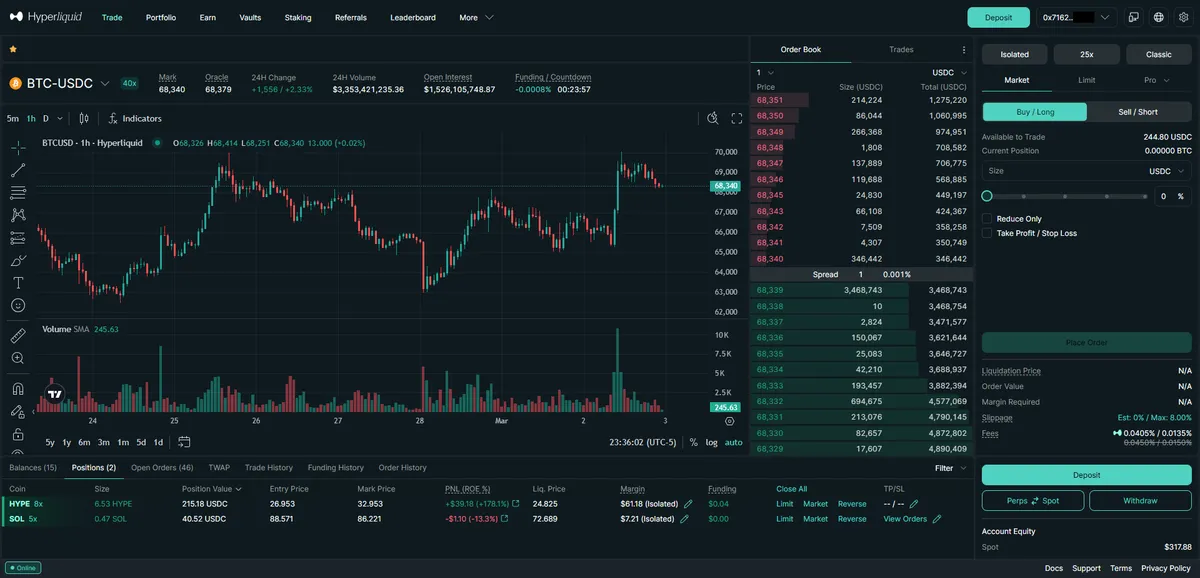
The practical distinction is the visibility of order state. Hyperliquid keeps the order book, matching and settlement in one trading chain, while dYdX uses a validator-operated book with settled fills recorded onchain. Record the same quote, cancel response, fill and final settlement on both venues instead of relying on a broad “fully onchain” or “app-chain” label.
The stronger execution case depends on the same market and order size, not the venue label. Hyperliquid gives a direct order-book workflow; dYdX adds a validator and chain-settlement layer. Compare the same contract on both trading surfaces and dYdX’s trading product.
Place the same small limit order on both venues. Record the spread, whether it rests or fills, the cancel response and the final fill price. Repeat with a small marketable order to compare price impact and settlement. Hyperliquid is the cleaner first test for visible order-book execution; dYdX is relevant when the trader specifically wants a dedicated derivatives-chain model.
Hyperliquid vs dYdX: which venue has the lower trading cost?
Hyperliquid is cheaper by 0.005 percentage points per side. The difference is small in percentage terms but measurable at size: on a $10,000 entry and exit, it equals $1 in favor of Hyperliquid before spread, funding and price impact are included.
| Cost measure | Hyperliquid | dYdX |
|---|---|---|
| Published base maker fee | 0.015% | 0.020% |
| Published base taker fee | 0.045% | 0.050% |
| $10,000 entry fee | $4.50 | $5.00 |
| $10,000 exit fee | $4.50 | $5.00 |
| $10,000 round-trip taker fees | $9.00 | $10.00 |
| $10,000 round-trip maker fees | $3.00 | $4.00 |
These are published base-tier rates, not an assumed example or a fee estimate invented for this article. The Hyperliquid maker and taker rates are reported in its public 2026 fee schedule reference; the dYdX rates are reported in its 2026 venue review: Hyperliquid fee schedule reference and dYdX fee review. Volume tiers, staking or referral discounts, builder charges and governance changes can alter the result, so the fee schedule should be rechecked before publication.
This creates two different fee conclusions. A taker comparing a $10,000 round trip saves $1 at Hyperliquid’s base tier. A maker placing and receiving both legs saves the same $1, but the starting bill is lower at both venues. If the order is likely to cross the spread, use the taker row; if it can rest without losing the trade, use the maker row instead of applying the taker headline to every strategy.
The fee table does not prove that Hyperliquid produces the cheaper completed trade. For the same BTC perpetual, the final comparison must add the displayed spread, realized price impact, funding paid or received, collateral-transfer cost and any liquidation-related charge. A $1 fee advantage disappears if the order receives only $1.01 worse execution on the round trip.
Funding also changes the trade decision. A trader holding a position for several days may care more about funding direction and interval than about a small entry-fee difference. A market maker may care about maker treatment and cancel behavior. A short-term directional trader may care most about spread and liquidation distance. Use the funding-rate market coverage when turning a live capture into a dated cost table.
Hyperliquid vs dYdX: how margin and liquidation exposure differ
The margin winner is the venue that gives the trader a clearer loss boundary for the same position. Do not compare maximum leverage alone; compare what happens to collateral when the mark price moves against the trade. Use the same market, collateral asset and margin mode on both venues.
| Margin and liquidation metric | Hyperliquid | dYdX |
|---|---|---|
| Reference maximum leverage | Up to 40x | Up to 25x |
| Margin modes | Cross and isolated | Cross and isolated subaccounts |
| Liquidation backstop | Protocol liquidation and HLP backstop | Liquidation engine and insurance-fund mechanism |
The leverage figures are reference limits from the 2026 comparison data checked for this draft, not a promise for every contract. The Hyperliquid review and dYdX review both note that leverage and contract rules vary by market.
Hyperliquid’s practical advantage is that the user can see the trading workflow directly from a wallet-oriented environment. That also means the user must protect the signing key, verify the chain, and separate trading collateral from long-term holdings. A liquidation event may involve a book and a backstop mechanism, so a “self-custody” label does not remove market-structure risk.
dYdX adds chain-account operations and validator-backed settlement to the margin test. Record the initial margin, maintenance requirement, mark price, liquidation price, partial-close behavior and response to a rejected transaction before increasing size. The margin and custody comparison gives the relevant account-risk context.
Hyperliquid vs dYdX: which custody and withdrawal path is easier to recover?
Hyperliquid is easier to reason about when the trader wants a wallet-first flow. dYdX adds chain-account, confirmation and withdrawal steps that must remain reliable when an operation is delayed.
Self-custody does not remove protocol, chain or liquidation risk. Centralized account custody does not remove counterparty risk either; it simply places recovery in a different system. The best perpetual DEXs cluster helps frame the protocol-custody side, while the best centralized exchanges guide provides the account-custody comparison.
Before funding more than a test balance, verify the wallet, collateral destination, deposit network, withdrawal route, reduce-only close and final fee/PnL record. Availability also matters: a wallet is not enough if the market, collateral route, interface or regional access is unavailable.
| Custody and withdrawal metric | Hyperliquid | dYdX |
|---|---|---|
| Trading gas at the venue | No gas for trading; network cost can apply when moving funds | No gas for trading; network cost applies to transfers |
| Example withdrawal route | USDC to Arbitrum; about $1 bridge fee and roughly 5 minutes in the cited review | Skip Go regular: about $0.10-$7 plus chain gas; fast route: 0.10% plus gas |
| Account model | Wallet-based, no conventional exchange account | Wallet and dYdX Chain account |
These figures describe the cited routes, not a universal withdrawal quote. The Hyperliquid review reports the Arbitrum withdrawal fee and timing, while the dYdX review reports the Skip Go ranges. The route, network and bridge provider should be checked again before a live transfer.
Hyperliquid vs dYdX: which venue fits each trader profile?
| Trader profile | Better first test | Why | What would change the answer |
|---|---|---|---|
| Self-custody trader | Hyperliquid | Direct wallet-oriented order-book workflow | Weak depth or unclear liquidation recovery |
| App-chain researcher | dYdX | Dedicated chain and derivatives operating model | Unclear chain status or withdrawal friction |
| Large BTC/ETH trader | Whichever wins the matched depth test | Realized spread matters more than branding | Different fill quality at actual notional |
| Automated trader | Neither until order and emergency-close tests pass | Order acknowledgement and recovery are decisive | Stale data, duplicate orders or key controls fail |
| Beginner | The simpler isolated-margin workflow | Clear loss boundary and withdrawal path | Interface hides mark or liquidation price |
For automated traders, use the bot support coverage instead of assuming that a visible trading connection means production readiness. For a larger order, also review the liquidity market context before testing the exact market.
Conclusion
Choose Hyperliquid when the priority is an onchain order-book experience that can be managed directly from a dedicated wallet. Choose dYdX when the dedicated chain and derivatives operating model are the reason for the trade. If the position is large, let the matched depth and realized slippage decide. If the position is automated, let acknowledgement, revoke, retry, and emergency-close tests decide.
Neither venue earns a durable winner label from architecture alone. Run the same small open-close-withdrawal test, refresh dynamic terms, and write down the observation that would remove each venue from the shortlist. That produces a defensible choice between two different operating models rather than a recycled DEX ranking.
FAQs
Is Hyperliquid more decentralized than dYdX?
The answer depends on which layer is being measured. Compare chain operation, matching, governance, custody, validators, market makers, and recovery separately. A broad “more decentralized” label hides the exact dependency that matters during a failed order or liquidation.
Which has lower fees, Hyperliquid or dYdX?
Do not answer from a static headline. Capture current fee terms and compare them with spread, funding, network cost, and realized execution for the same notional. The cheaper posted rate can still produce a more expensive round trip.
Can I use either venue without a centralized exchange account?
Both are designed around decentralized product workflows, but the exact wallet, account, collateral, and regional conditions must be verified before funding. A wallet connection does not remove protocol or chain risk.
Which is better for a trading bot?
Choose only after testing market-data freshness, order acknowledgements, duplicate retries, rate limits, reduce-only closing, key permissions, and emergency stop behavior. A bot needs predictable operations more than a large market list.
Disclaimer: This article is for informational purposes only and does not constitute financial or investment advice. Cryptocurrency and digital asset markets carry significant risk. Always do your own research before making decisions.