





Hyperliquid is the better venue for traders who need an order book, broader order control and a measurable bid-to-fill path. Jupiter Perps is the better fit for Solana users who value a familiar wallet route and accept oracle-priced execution backed by the JLP pool.
The difference is not simply one chain against another. Hyperliquid prices a trade through displayed liquidity and maker-taker behavior, while Jupiter prices it through an oracle, a fixed position fee, pool imbalance and hourly borrow. That structural split determines which venue is cheaper for a particular position.

Hyperliquid vs Jupiter Perps: direct structural comparison
| Decision factor | Hyperliquid | Jupiter Perps | Edge |
|---|---|---|---|
| Execution model | Onchain central limit order book | Oracle-priced perpetuals against JLP | Strategy-specific |
| Order control | Market, limit, stop, scale and TWAP-style workflows | Position entry and trigger controls without a public CLOB queue | Hyperliquid |
| Price-impact evidence | Spread, visible depth and average fill | Linear and imbalance-related price-impact components | Depends on tested size |
| Base position fee | Live maker/taker tier | 0.06% to open and 0.06% to close in the reviewed schedule | Hyperliquid may win for active makers |
| Holding charge | Funding exchanged between sides | Hourly borrow linked to pool utilization | Depends on direction and duration |
| Counterparty structure | Traders and market makers in an order book | JLP pool supplies counterparty liquidity | Different risk boundaries |
| Wallet route | Deposit into the Hyperliquid environment | Solana wallet and Jupiter route | Jupiter for existing Solana users |
| Strongest fit | Active traders, passive orders and wider execution control | Supported Solana-native directional positions | User-specific |
This is not another general ranking. The broader perpetual DEX guide helps produce a shortlist, while this comparison resolves one narrow choice: visible book execution versus a Solana pool route.
Hyperliquid gives the trader more control over how an order enters the market. Jupiter gives the trader a simpler route from a Solana wallet into its supported perpetual markets. Convenience becomes an advantage only when the final execution cost and recovery path remain acceptable.
Price formation: book fills versus oracle price and JLP impact
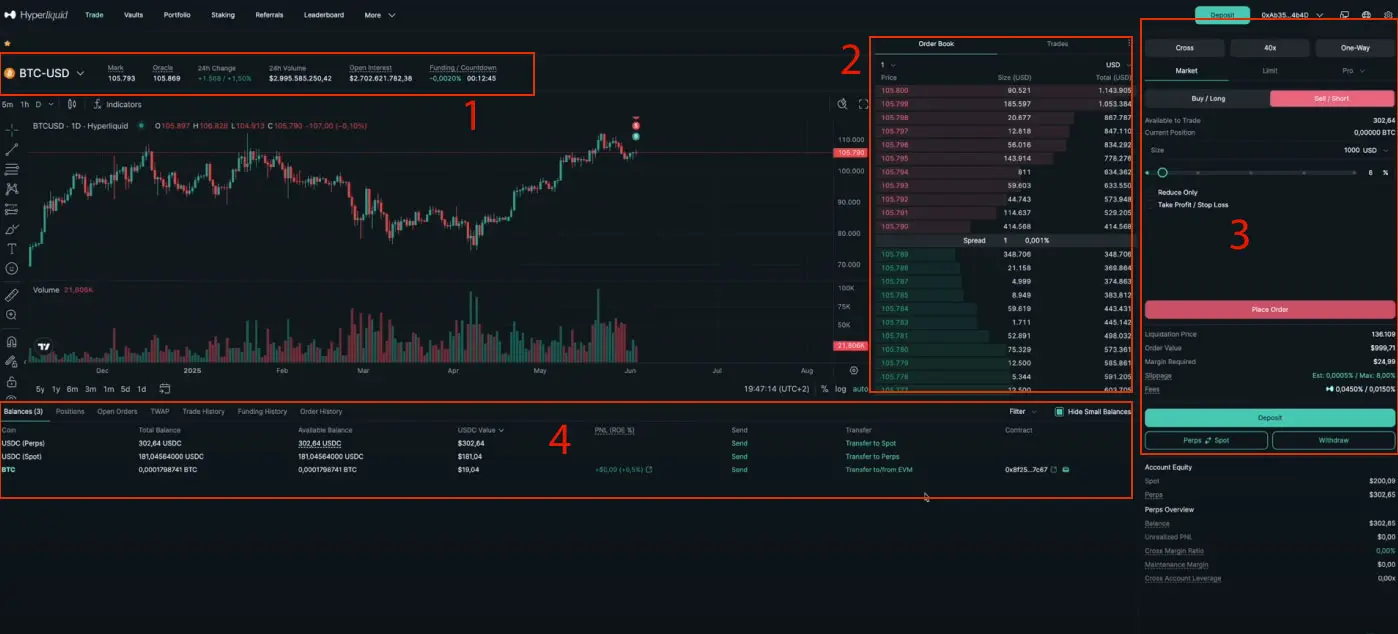
The Hyperliquid trading surface shows bids, asks, resting size and recent trades. A market order pays the account’s taker rate and crosses available levels. A limit order may earn a lower fee or rebate, but it can remain unfilled or be selected only when the market is moving against the quote.
That structure makes a fill reproducible. The trader can record the spread before submission, average execution, filled quantity and price impact at the chosen notional. The result can then be compared with Coinwy’s analysis of perpetual liquidity and fee generation without treating total protocol volume as executable depth.
The Jupiter Perps product does not expose the same queue. Its entry price begins with an oracle reference, then the protocol applies a 0.06% opening fee and a price-impact adjustment. The impact model includes a trade-size component and an imbalance component, so the final result can be better or worse depending on direction and JLP conditions.
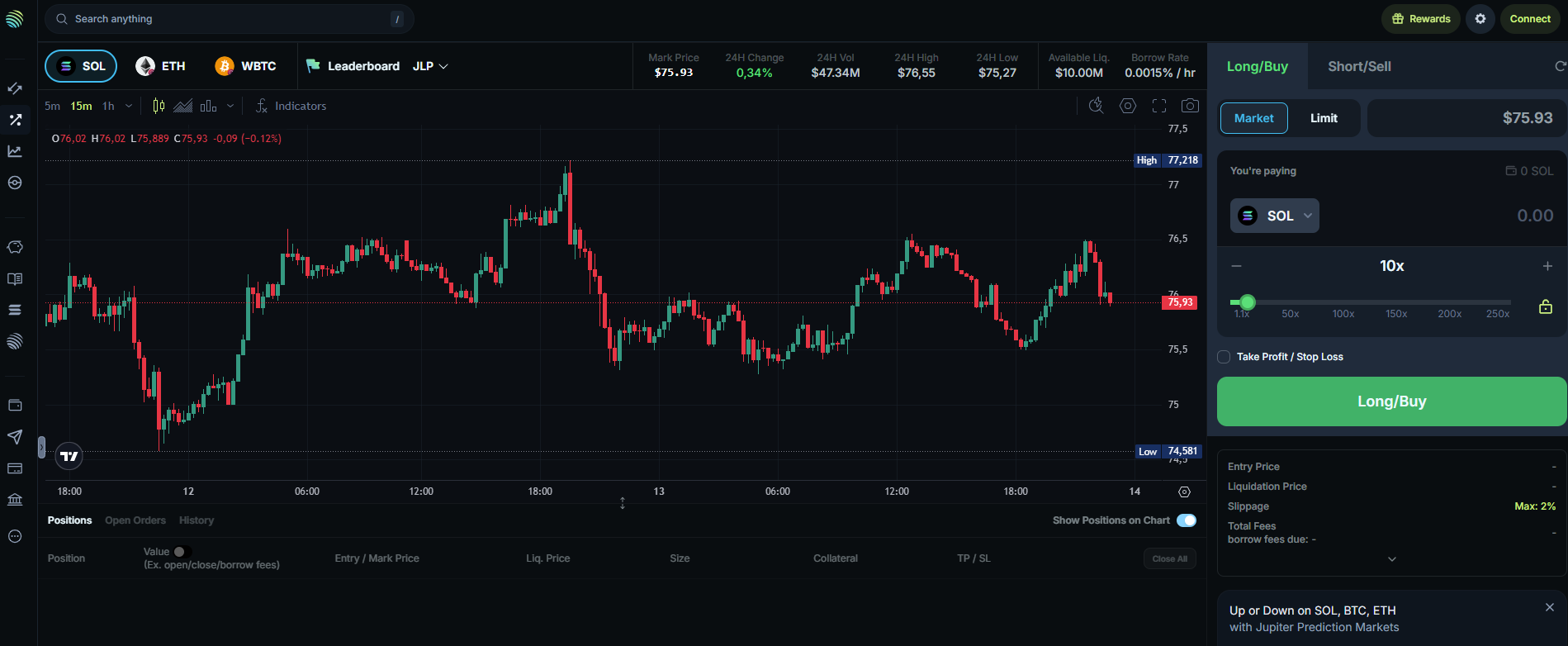
Jupiter’s absence of an order-book sweep does not mean costless execution. A trader needs the quoted entry, impact charge, collateral debit and final position size. The same fields must be captured again on exit because a position that initially improves pool balance can close under different conditions.
Why Jupiter’s 0.06% fee does not settle the comparison
Jupiter charges 0.06% when opening and another 0.06% when closing under the reviewed schedule. The base position charge is therefore calculated from the actual entry and exit notionals, not from a sample account size. Price impact, hourly borrow and Solana route costs are then added, while a balance-improving trade may receive a favorable impact adjustment.
Hyperliquid starts from the account’s live maker or taker rate. The trader then adds the difference between the decision price and average book fill, cumulative funding, and deposit or withdrawal costs. A passive fill can reduce explicit cost but introduces waiting and non-fill risk; a taker order replaces that uncertainty with an immediately measurable spread and impact.
| Position event | Hyperliquid evidence | Jupiter Perps evidence |
|---|---|---|
| Entry | Fee tier, order type, decision price and average fill | Entry notional x 0.06%, quoted impact and collateral debit |
| Holding period | Each funding settlement | Each hourly borrow accrual |
| Exit | Exit fee, spread and average fill | Exit notional x 0.06%, closing impact and collateral returned |
| Failed or partial execution | Unfilled quantity and remaining order state | Rejected transaction, changed quote or route state |
This event-based comparison fits the products better than one fixed dollar example. Hyperliquid wins when its order controls produce a better average fill after fees and funding. Jupiter wins when the convenience of its Solana route and pool-priced execution leave more collateral after every position event has been reconciled.
Market access and order control are separate advantages
Hyperliquid supports an order-book workflow across a wider trading environment. Its public interface allows market, limit, stop and more structured execution. Traders who split entries, rest passive orders or schedule a TWAP can express that plan directly rather than converting it into one pool-priced position.
Jupiter’s advantage is route familiarity. A user already operating in the Jupiter ecosystem can stay within a familiar Solana wallet context and access supported perpetual markets without learning a separate order-book interface. That does not make Jupiter the better altcoin venue. Contract availability, collateral and size limits must match the intended trade.
A Solana trader reported in a first-hand Jupiter Perps discussion that an earlier version centered on BTC, ETH and SOL. The comment was accessed August 11, 2026 and should not be read as a current market list. It does identify the correct verification point: Jupiter’s route convenience has value only when the required contract is actually available with adequate pool capacity.
| Execution need | Hyperliquid | Jupiter Perps |
|---|---|---|
| Rest a limit order | Native order-book use case | No equivalent public queue |
| Split a large entry | Limit, scale or TWAP workflow | Several separately priced pool entries |
| Verify exact depth | Visible by price level | Inferred from quote, limits and impact |
| Use an existing Solana wallet | Additional environment and deposit route | Native product advantage |
| Trade only supported majors | Strong order control | Simple route can be competitive |
| Seek broad contract choice | Stronger first comparison | Confirm current product inventory |
Carry cost: funding versus hourly pool borrowing
Hyperliquid’s carry is dominated by funding. The useful measure is cumulative funding over the intended holding period, not the latest displayed interval. A trader can combine that debit or credit with executed fees and spread to calculate a complete position result.
Jupiter applies a borrow fee that accrues hourly and responds to JLP utilization. The rate represents the cost of using liquidity supplied by the pool. A popular direction can become more expensive as utilization rises, even when the opening fee remains fixed at 0.06%.
This difference changes the preferred holding period. Hyperliquid is easier to model for a strategy already built around perpetual funding. Jupiter can remain competitive for a short position with favorable impact, yet an extended hold needs a separate borrow projection. The Coinwy funding analysis should not be copied directly into Jupiter’s cost model because borrow and funding are not interchangeable labels.
Counterparty and liquidation exposure
Hyperliquid routes normal trading through its book and forced closure through its liquidation system, with a backstop available when ordinary execution is insufficient. The trader controls the signing wallet but remains exposed to protocol state, chain operations, market depth and the liquidation route.
Jupiter Perps uses JLP as the pool-side counterparty. Trader profit and loss, borrow, price impact and pool capacity are therefore connected. The JLP earning interface represents a separate investment decision from opening a perpetual position. A profitable trade experience does not establish that JLP offers an attractive risk-adjusted return.
| Risk boundary | Hyperliquid | Jupiter Perps |
|---|---|---|
| Market price evidence | Order book and protocol mark | Oracle reference plus impact model |
| Liquidity source | Market makers and resting orders | JLP assets and utilization |
| Forced-close sensitivity | Book depth and maintenance margin | Oracle price, collateral, impact and pool conditions |
| Additional exposure | Chain and backstop behavior | Solana state, JLP capacity and account route |
| User protection | Lower leverage, isolated collateral and wallet separation | Lower leverage, suitable collateral and route monitoring |
Jupiter is not safer merely because the quote avoids a visible book sweep. Hyperliquid is not safer merely because the trader signs from a wallet. The oracle-exploit case study illustrates why oracle, collateral and liquidation mechanics need to be reviewed together.
Wallet recovery differs more than the interfaces suggest
Hyperliquid requires the user to understand the deposit asset, destination environment, wallet key and withdrawal route. A failed or delayed action should be reconciled against both wallet history and the venue’s public state. The Hyperliquid foundation site and public statistics surface provide context, but the account’s own transaction trail remains the recovery record.
Jupiter adds Solana transaction confirmation and token-account behavior to the process. Its familiar interface can reduce navigation friction for an existing Solana user, but the trader still needs enough SOL for transactions, the correct collateral account and a verified withdrawal destination. A clean UI does not remove chain congestion, rejected transaction or wallet-compromise risk.
Long-term assets should remain separate from either trading route. A dedicated wallet limits the value exposed to signing, open positions and protocol permissions. Coinwy’s coverage of automated trading agents reinforces the same boundary for software-controlled wallets.
The best venue depends on the intended trade
| Intended workflow | Better first choice | Reason |
|---|---|---|
| Passive limit entry | Hyperliquid | Resting order and queue control |
| TWAP or scaled execution | Hyperliquid | More explicit order tooling |
| Existing Solana user trading a supported market | Jupiter Perps | Shorter wallet and ecosystem route |
| Short-duration trade with favorable pool impact | Compare both | Jupiter’s fixed rate may still beat or lose to the realized book fill |
| Multi-day position during high JLP utilization | Hyperliquid first | Jupiter borrow can compound hourly |
| Need to inspect executable depth before submission | Hyperliquid | Public order-book evidence |
Conclusion
Hyperliquid wins for traders who require granular order control, visible depth and a cost model built from maker-taker fees, spread and funding. Jupiter Perps wins for an existing Solana user when the required market is supported and the complete oracle-priced result, including the 0.06% opening and closing fees, impact and borrow, is lower.
The two products should not be ranked from interface speed. Hyperliquid should be judged by average fill and cumulative funding. Jupiter should be judged by quoted entry, price impact, JLP utilization, hourly borrow and collateral returned after close. The lower verified lifecycle cost is the only defensible winner for the selected trade.
FAQs
Is Hyperliquid cheaper than Jupiter Perps?
It can be cheaper for passive or low-impact order-book execution. Jupiter begins with a 0.06% opening fee and a 0.06% closing fee, while its price impact and borrow can improve or worsen the total.
Does Jupiter Perps have order-book slippage?
Jupiter does not use the same public CLOB queue, but its price-impact mechanism still changes the final execution. Oracle pricing does not guarantee a zero-cost fill.
Which venue is better for altcoin perpetuals?
Hyperliquid is the stronger first comparison when broader contract choice and order control matter. Jupiter remains appropriate only where the required market, collateral and pool capacity are available.
Does a Solana wallet make Jupiter Perps safer?
No. It makes the route more familiar for a Solana user. Protocol, oracle, pool, liquidation, transaction and key-management risks remain.
Disclaimer: This article is for informational purposes only and does not constitute financial or investment advice. Cryptocurrency and digital asset markets carry significant risk. Always do your own research before making decisions.
Related: High-yield bonds back AI/HPC builds amid execution risk
Related: Hyperliquid vs dYdX in 2026: Liquidity, Fees and Decentralization



